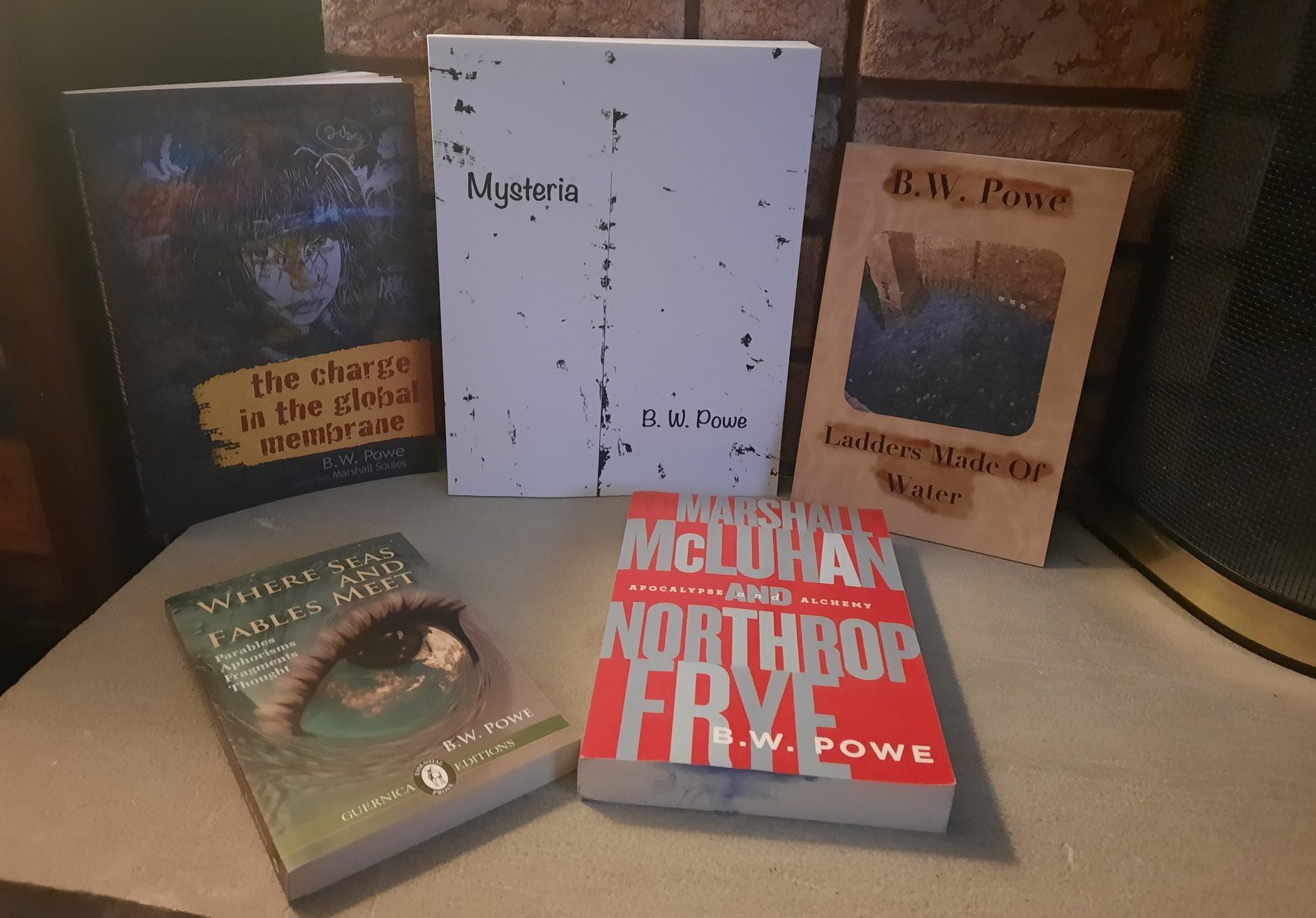
Review of B. W. Powe’s Marshall McLuhan and Northrup Frye: Apocalypse and Alchemy by Robert K. Logan
B. W. Powe’s book Marshall McLuhan and Northrup Frye: Apocalypse and Alchemy is a masterpiece of literary criticism of two of Canada’s (nay the world’s) greatest literary critics, Marshall McLuhan and Northrup Frye. The content of Powe’s book is a detailed and astute analysis and comparison of these two seminal poetic thinkers and the medium is Powe’s poetic prose that is a delight to read. Powe’s goal “is to initiate a discussion of the convergence, of the conflicts, of the methods and harmonies, and of the ‘ideal Marriage’ of communications and literature (‘Mercury and Philology’) which their lives and thought bravely embody (54, these numbers refer to pages in Powe’s text).” Elsewhere (21) he writes, “the premise of my book [is] that the intellectual energies of McLuhan and Frye continue to be ‘magnetic fields’; they attract and resist each other in the apocalyptic mode.” Powe’s book is not just an academic exercise but a process that he is heavily invested in both emotionally and intellectually for both McLuhan and Frye were his teachers and the inspiration for his life’s work as an academic writer, a novelist, an essayist, a critic and a poet.
The subtitle of Powe’s book: Apocalypse and Alchemy holds the key to understanding his project. Powe sees both McLuhan and Frye as apocalyptic thinkers. He quotes Frye from The Educated Imagination, “Literature is a human apocalypse, man’s revelation to man, and criticism  is not a body of adjudication, but the awareness of that revelation, the last judgment of mankind (20-21).” Powe’s (16) evidence for McLuhan’s apocalyptic spirit comes from The Medium and the Light where McLuhan writes, “I am an apocalyptic… We are on the verge of apocalypse.” Powe interprets this passage to mean, “Apocalypse is heightened awareness, the moment of epiphany, where an individual sees into, or acutely apprehends, his or her time and place (16).” Although Powe sees both McLuhan and Frye as apocalyptic thinkers their notion of apocalypse is quite different. “To McLuhan, apocalypse is found in the forms and effects of media,… to Frye, apocalypse can be found in literature and through the honed awareness that comes in critical comprehension (23).”
The alchemy for Powe and one of the missions of his book is his desire to reconcile and amalgamate the thinking of his two mentors. He writes, “Is there a possibility of a McLuhan-Frye alchemy, a mixing of their chemical traces and energies? What happens if we let the two together become the catalysts for a new agency of thought, a code of thought and inspiration (11)? ”
The structure of the book revolves around this theme of apocalypse and alchemy. After a short prologue that deals with the first encounter of McLuhan and Frye in 1946 at the University of Toronto, Chapter 1 reveals the authors intentions and provides an overview of his notion of apocalypse and alchemy. Chapter 2 describes the work of McLuhan and Frye from their own respective perspectives. Chapter 3 deals with the conflict between McLuhan and Frye’s differing apocalyptic views and approaches. Chapter 4 examines the parallels or harmonies in their thinking leading to Chapter 5 where Powe attempts an alchemic reconciliation of the approaches of McLuhan and Fry. A short Chapter 6 sums up the book and deals with the impact that McLuhan and Fry have had on the thinking and work of their mutual student and prodigy, the author of the book.
There are studies of McLuhan and there are studies of Frye but Powe’s book is unique in that he takes on both these scholars at the same time, compares them and examines their interactions with each other. Rarely do we find an analysis of two thinkers compared side by side and in those odd cases where it has been done not by a student and admirer of the two thinkers in question. One of the interesting features of Powe’s study is that he is the student of both, engaged in a struggle with them to embrace them and as their former student to also turn away from them. Powe invokes the story of Jacob wrestling with an angel to describe his own struggle. The difference here is that Jacob only wrestled one angel whereas Powe takes on two angels as he relates in his text, “Still I know when I rise to struggle with these angels of instruction and inspiration what comes is a reinvention of the two through a recombination (27).” This book is as much an autobiography of Powe’s intellectual heritage as it is an analysis of McLuhan and Frye, two thinkers that are at the core of Powe’s scholarship and his literary artistic expression. In this book we are treated to a view of the figure of McLuhan in the ground of Frye, a view of the figure of Frye in the ground of McLuhan, and a view of the figure of McLuhan and Frye in the ground of Powe, a rich tapestry indeed!
But there is still another ground and that is the ground of Canada as Powe, himself a Canadian, describes the influence of being Canadian on Frye and McLuhan who chose to work and remain in Canada despite the possibilities of lucrative offers from south of the border (35). Powe suggests that they are neither part of the European nor the American tradition but they are “subtly, insistently part of the new that is Canadian and yet (paradoxically) universal (12).” So in a certain sense this book is about Canada as well as about McLuhan, Frye and Powe.
I learned a lot from Powe about Frye whose work was not as familiar to me as that of McLuhan’s. But what really knocked me out were the new insights into McLuhan that Powe provided despite the fact that I had collaborated with McLuhan from 1974 to his passing in 1980 and have written about him ever since. I believe it is Powe’s poetic sensibilities that allowed him to draw fresh insights for me into McLuhan’s work.
Powe introduces us to how McLuhan and Frye worked for many years at St. Michael’s and Victoria respectively where the street running through St.Mike’s was renamed the McLuhan Way and a classroom building renamed Northrup Frye Hall. Powe writes, “The naming of a street and building can guide us and move us. It helps us to remember twin geniuses and their invaluable creation of a legacy of insight and vision (10).” How appropriate, I thought, how these naming honours reflect the character of the honourees. McLuhan is a way, a thoroughfare, a place of movement and Frye is a building, static and solid and built conforming to a code, the Toronto building code.
Powe first describes the work of McLuhan and Frye in terms of each one’s own objectives before contrasting their respective perspectives and interests which for McLuhan was a focus on form, media and the impact of technology and media and for Frye was a focus on content and the impact on our imagination (39). There was also a difference in their style as McLuhan despite being a prolific author worked primarily in acoustic space within the framework of the oral tradition and without a theory whereas Fry worked totally in visual space within the literary tradition guided by his theory of the Great Code (51, 149, 167). McLuhan “craved collaborators” (85) and Fry worked alone in the library or his study with his books (50).
Despite these contrasts in style, temperament and methodology, Powe still sees many parallels in McLuhan and Frye. These became the ingredients for his alchemic reconciliation of his two teachers and mentors. Both were voracious readers, both were interested in patterns, laws and codes (41, 202), both were fascinated with the number four as well as Pentecostal and apocalyptic thinking (29-34). Both had strong religious convictions, although different they were deeply felt (46). Education was a major concern for both (48). Each was rebellious in his own way (181) and each was fascinated with Joyce’s Finnegans Wake (183), as was Powe, who treated us to his own analysis of the Wake (204-08) in addition to those of McLuhan and Frye.
Despite these parallels and the ‘harmonies’ in the two seers, Powe deals with what he calls “the critical conflict between McLuhan and Frye” devoting an entire chapter to this topic (110-168). Their critiques of each other and conflict between them, Powe suggests, rose to the level of mutual polemics. McLuhan’s problem with Frye was that he felt Frye was operating with a left-brain, visual bias of categorization by classifying figures without taking into account the ground in which they operated. He also critiqued Frye for not taking into account the effects of the print medium (122), and went as far as to suggest that Frye’s “classification” was “without insight (117),” which seems a bit harsh. Frye, for his part, suggested that McLuhan was “a cult figure” who “allowed his name and ideas to be associated with business people and media celebrities, politicians and advertisers (127).” Powe also cites a 1971 essay in which Frye accuses McLuhan of being a determinist and even a Marxist. This seems a bit unfair to McLuhan given his ecological approach and his criticism of Marxists as providing a 19th century perspective on 20thcentury problems.
After his careful analysis of McLuhan and Frye’s differences, parallels, critical conflicts and even their mutual polemics, Powe turns to alchemy in his attempt to identify a “visionary prophetic tradition in the joining of ‘the medium is the message’ with the Great Code story (237).” He suggests that, “we meld McLuhan’s percepts with Frye’s concepts (229).” McLuhan and Frye are described in yin and yang terms by Powe when he writes, “in McLuhan’s poetic aphorisms there is criticism and in Frye’s criticism poetry (269).” Of the two McLuhan is the yang with his assertive, in your face, sociality and Frye is the yin with his withdrawn, solitary, bookish scholarship. McLuhan enters the lists with business folks, entertainers, politicians, artists and the common folk of his society whereas Frye is withdrawn quietly contemplating his books in the quiet sanctuary of his ivory tower. McLuhan’s classes are adlibbed while Frye’s lectures are carefully prepared ahead of time. McLuhan is incessantly talking and Frye, incessantly writing either for his public or in his private notebooks.
Powe found intellectual and spiritual succour and nourishment from both of his mentors and teachers, who he knew intimately in their lifetime, studied assiduously in his academic career and defended in his book against their harshest critics such as A. C. Hamilton, U. Eco and J. Baudrillard (260). In summing up the impact McLuhan and Frye on him Powe writes, “their primary gift was their attempt to provide ways to let us soar (276),” but still he learned to “abandon them to move on, living deeply” yet to come back to them on occasion so that “other new and vital lessons [could] begin (285).” If you read Powe’s book, an important addition to McLuhan and Frye scholarship, you too will experience new and vital lessons.
______________________




 BW Powe