B.W. Powe’s Tribute to Alice Munro on Her Passing, May 13th, 2024

By B.W. Powe

And now I’m meditating on Alice Munro’s passing. She left us at age 92, after a long period in dementia.
One of the greatest short story writers. I’ve wanted to say something about her for years.

You know—weird thing—I didn’t read her closely for a long time. Then I began reflecting on her writings when I was living in Spain. Suddenly, there, reading her when I was far away from Canada, the power of her stories and the style she embodied burst over me, occupying my thoughts.

Alone on a train, going from Barcelona to a town outside the city, reading Hateship, Friendship, Courtship, Loveship, Marriage, not comprehending the Castilian and Catalan spoken by other passengers, her words and sentences, her voice and characters became uncannily vivid, somehow lucidly enigmatic. What did this mean?

When I read her in Canada, she seemed a realist writer, reporting on lives in small town Ontario. When I read her in Spain, the hermetic side of her work struck me in my rootless state: I saw and felt the strangeness, how intensive her observational stances were—her narrators standing by, always outside (alone in their thoughts and contemplations) yet recording without blinkers or screens, illuminating how people and their worlds don’t and can’t abide or comprehend realities.

She was one of The Watchers—one who sees, hovers close. Her hermetic undercurrents: she never moralized, never prized style above all; the situations and conditions of lives came to her without ideology, didactic agendas, transcendental imperatives or religious creeds, satiric demolitions, or lyric exaltations. And yet she saw, and saw more, and contemplated and caught many lives unfolding. The short story was her fragment of the splendor; but the form’s condensations and strict practice meant much had to be omitted, or hidden, including any reference to that splendor.​

When I was in Cordoba, I imagined a debate between Alice Munro and Don Quixote: The Watcher talking to the Mad Knight of Sorrows.
Who’s to say what’s real? Suffering imprints us with what we call reality; and the imagination provokes us into figuring there must be a transcendental or idealist purpose, somewhere.
This would be the crux of the Munro-Quixote debate. A writer from historical time arguing with a mythic character.
One who records illusions, one who champions illusions.
They could express and counter how the observer changes the observed, and how the observed changes the observer.
One saying, “Here are false hopes”, one saying, “A false hope is at least something…”
Maybe both would say, “Show me your despair, I already know about love…”
I could never imagine anything but a stalemate in their argument.

Munro evaded large metaphysical questions in story collections with titles like The Moons of JupiterDear Life, The Progress of Love, and Something I’ve been Meaning to Tell You that appear to suggest the presence of those questions. Still the poetic spirit, in the ambiguities between the lines of her stories, seemed to me to be speaking of them.

I said in Canada she’s understood to be a realist; but when I continued to read her in Spain—where she’s also taken to be a realist—I sensed the mythic implications in the crucial small scale of the lives she envisioned. The ordinary doesn’t become miraculous in her writings. The ordinary becomes an intensified locus of the inexplicable​, a place where our inner lives are describable but finally unknowable. The Watcher recognizes and documents how our notions of the real are wounds. Her writer-surrogates acknowledge how detached they are from…life, and yet implicated in it.

To this day I prefer reading Munro in Spain (and primarily in Andalusia, the southernmost province). This is because in another place her accomplishments seem even more memorable.  Her stories, where vastness and scale implode (compress), become microcosms of an uncovering, and we witness people living in their thwarted, secretive conditions. She invites us to quieten our roaring selves, to concentrate on details and gestures we miss. The Watcher sees the turmoil of the surface and the lives within surging, leaving their traces in poised fictional expressions.

And we should recognize this sublime paradox: her seemingly real town, based on Wingham, in southern Ontario, her keenly sketched people, belong to fictive domains. She imagined it all, all of them—the historical locales and the locals themselves were subsumed into her imagining. This means her stories (always condensed to the point of almost becoming splinters—moving toward abrupt glimpses) endure in the mythic dimension where her town aligns with Flaubert’s Yonville, Joyce’s Dublin, Borges’ Buenos Aires’ streets, Hemingway’s Michigan lakeside towns and Paris arrondissements, Faulkner’s Yoknapatawpha County, Dinesen’s Ngong Hills, Ferrante’s Neapolitan suburb, Cohen’s Montreal, Atwood’s downtown Toronto, and Carson’s El Camino. We’ll remember the town and the people because Munro dreamed them well and then wrote and revised them into being. In this way, her creations will, and must, stay ahead of her interpreters and biographers.

Munro with McLuhan, Frye, Cohen, Carson, and Atwood—the central imaginative poets and storytellers, mythographers, and Watchers of our climate…

And with our world environments overheating to extinguish us one day—burn us down, burn us out—I propose Munro’s collections should be set in protected sites. Like cairns. So that future entities (whatever the hybrids of AI and flesh may be) will find her work. When they do, and they’ve learned to decode her nuanced writing, they could read deeply into her stories’ brevities, and be altered by their depths. They would surely find how they show our humanity in the way it once thrived, before the extinction or before the digital transfigurations of being, in our bewildering complexities, in our gasps of living and inwardness.

The fascination with her enigmas. How her books can be easily absorbed in the immediacy of reading, when we respond to her agile and surprising stories, and yet never can we reach complete understanding.​ And why should we? The strangeness is all.

Post-Script to A Tribute to Alice Munro
By B.W. Powe

Once I met Munro at Albert Britnell’s Bookstore on Yonge Street in downtown Toronto. Briefly. I’d been asking the bookseller about Cormac McCarthy’s All the Pretty Horses, which had just been published. I wanted to know how it was selling at the store. I knew his books had long languished in overlooked or forgotten margins. She said, “This one’s doing well.”

Then I turned around and saw Munro. Very affable. She said
she knew McCarthy’s books, admiring his strange eloquence and harrowing honesty. Sometimes I think she said “stranger,” not strange. And then she was gone.
Music Inspired by B.W. Powe’s book, Ladders Made of Water

In this collection of songs, Michael Mahy’s receptiveness and love of poetry shines as an accompaniment to B.W. Powe’s words. Surrender Row is comprised of selections of lyrics from Surrender Row: A Discarnate Rock Opera, written by Powe. Poetry and music together as an evocative artistic statement in synthesized atmospheres, digital signals, analogue waves, distortion, an acoustic guitar, and a rock and roll heart. Mahy’s voice haunts and flutters while the words offer a world of lingering questioning and reflecting.

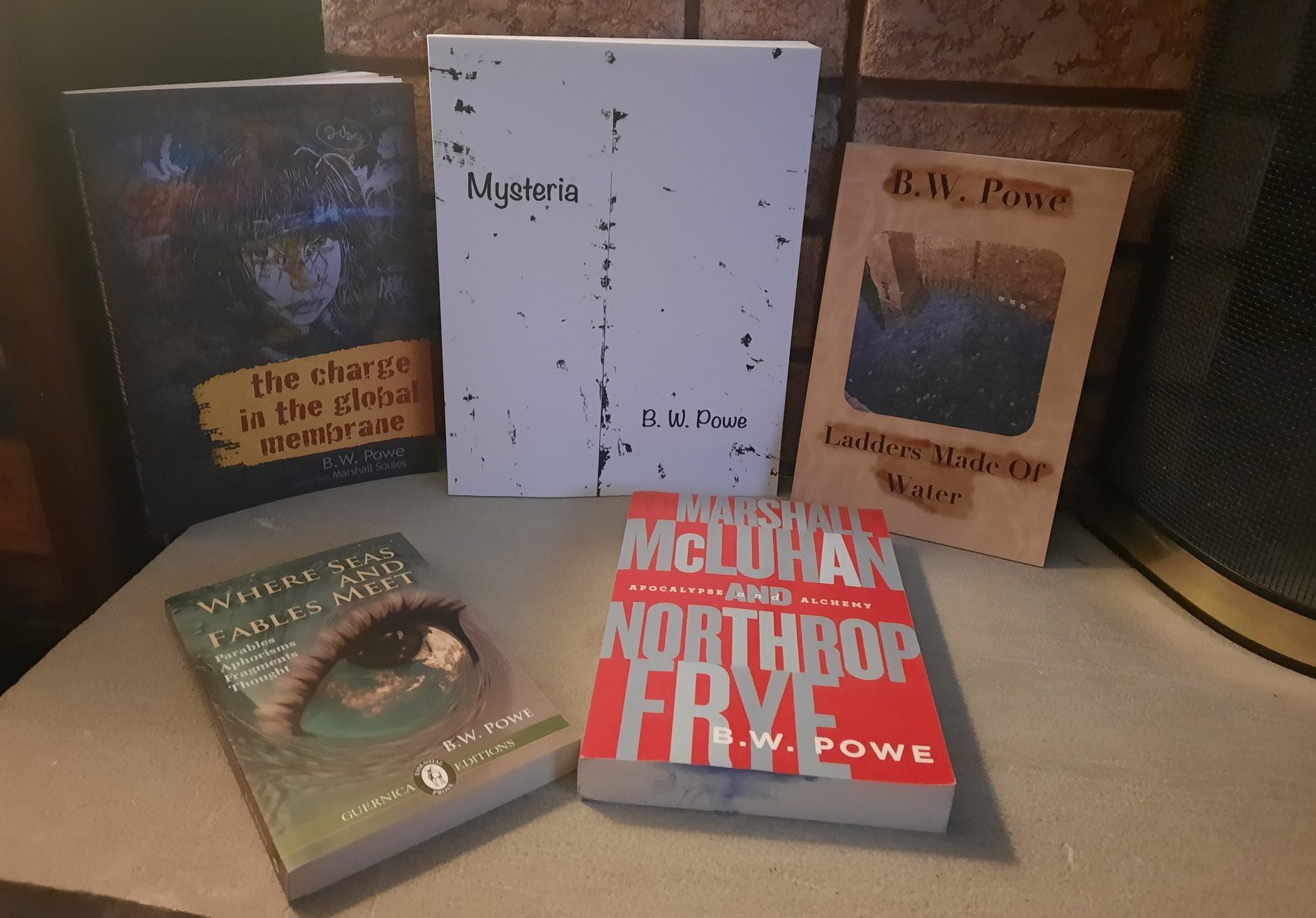
Powe’s lyrics form part of his book Ladders Made of Water, published by Stream Elsewhere Press (2023). It is the second book of a trilogy, which began with The Charge in the Global Membrane (2019) and is to be completed with the to-be-published Mysteria (2024). Ladders Made of Water offers the immediacy of the visionary Canadian poet, philosopher, essayist, and scholar’s work.

Click on the image to access the compositions

A Recent Issue of the Journal New Explorations on B.W. Powe

Click the image to access Vol. 3 No. 2(2023)
Click the image to access the article

‘Literature Only’ Podcast: “Crisis, Eudaimonia, and Creativity: A Conversation with Poet/Professor B.W. Powe, Thomas Worthington and David J. Clarke.

Click the image to access the podcast on Apple Podcasts
Click the image to access the podcast on Spotify
Click the image to access the podcast on Google Podcasts

From June 16 th , 2023, a Draft of a Memorial for Cormac McCarthy

To the last Readers of Books, wherever you may be.

Mourning the passing of author, Cormac McCarthy.
Sync… I spoke about him on Monday in my James Joyce Riverrun Talk via Zoom-link in
Montreal.

Absorbing his recent books, The Passenger and Stella Maris—I would have footnoted them for my Joyce talk, if there had been a place to put such notes.

I’ve been reading him and reviewing his books for decades. A long sometimes darkening conversation with one I never met. In my imagination another friend, another mentor. Deeply brave in confronting the dark. Unparalleled use of language sometimes countering, or counterpointing, the gravity of his vision. Oral rich phrasings elevated tales of frontiers. His stories and images pressed darkness and madness to reveal themselves. In his later books, rare but moving moments of compassion—hands reaching out to other hands in the light-dark, people holding hands with an enigmatic other—scenes that astonished.

Much more to say… And if we truly lived in a literary alphabetic culture there would be
conversations about him everywhere. Homages, honourings, for Suttree and Blood Meridian, the Border Trilogy and The Stonemason. Sadly, people may know him only from the largely failed movie versions of his books; No Country for Old Men and The Counsellor being notable exceptions. No movie-maker has truly been able to catch in cinema-pictures what McCarthy relays in words.

On a personal note, I was moved by the depiction of the valiant but at times reckless John Grady Cole in All the Pretty Horses, and I named my son after him. So that my son could, someday, find the story of a boy who came out of the desert after excruciating lessons of revenging violence.

Be at peace, Cormac McCarthy; and thank you, for your words and stories, for the unrelenting integrity of vision, for your spasms of stark humour, for the devotions that we find in your sentences and images.
We mourn much these days and nights, given the losses to the Pandemic and to wars of every kind, given the sagging and scorched moods we carry. Still, I’ll do my best today, tonight, and later, and on, to remember and eulogize you.

PS
Was McCarthy one of the last Modernists? With Alice Munro, Thomas Pynchon, Toni Morrison, Don DeLillo, Elena Ferrante.

I’d say so. McCarthy… Like one on an island, somewhere, fighting a twilight battle in a war that ended long ago (unknown to the fighter). Into the depths with an abiding seriousness about language and form. What comes surging through words when they’re impressed into evoking lucidities and ambiguities, infinite fluidities. I suppose I’d have to include myself in this errant process. (In my dreams, to be in such august company). But … surely contemporary subject matter—the advent of A.I. and the global all—with faint glimmerings of the Modernist sensibility…

PPS
Once I met Alice Munro at Albert Britnell’s Bookstore in Toronto. Briefly. I’d been asking about McCarthy’s All the Pretty Horses, which had just been published. I wanted to know how it was selling at the store. I knew his books had long languished in overlooked or forgotten margins. The bookseller said, this one’s doing well. Then I turned around and saw Munro. Very affable. She said she knew McCarthy’s work, admiring his strange eloquence and harrowing honesty. Sometimes I think she said ‘stranger’, not strange. And then she was gone.

B.W. Powe, Cordoba Spain

Hybrid Event: Presentation on James Joyce by Professor B.W. Powe (June 12, 2023)

June 12, 2023
2:00 pm (EST Time zone)

Hybrid Presentation on James Joyce by Professor B.W. Powe, followed by Q&A.
To access the Zoom link, please register online.

Review of B.W. Powe’s Recent Book Ladders Made of Water by Thomas Cooper

When you are reading LADDERS MADE OF WATER, you are immersing yourself in one of the great poetic minds of our century.   I love Powe’s writing and hope you’ll buy this book.  Both of us were students of Marshall McLuhan, and B.W’s writing about the Man of LaManitoba (McLuhan) is among the most knowledgeable, sensitive, and helpful.  Powe wrote the definitive book about the McLuhan-Frye relationship and is an important, top commentator about the poets, artists, and communication of our day.  A professor at York, BW is also a masterful teacher, so using his books in the classroom is a real plus for students.  LADDERS MADE OF WATER has my highest recommendation.

By Thomas Cooper PhD,
Emeritus Professor, Emerson College

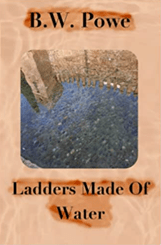
BW Powe’s new book: Ladders Made of Water. Now available online.

Click in this image to access the Canadian site

You’ll find Included in this collection a selection of public presentations and thoughts on our spiritual and ecological crises, including reflections on Jacques Ellul, Simone Weil, Teilhard de Chardin, Marshall McLuhan and Anne Carson, lyrics for an unfinished rock opera, a dramatic homily on Harry Potter, meditations on Dune Part One, Nomadland and Eternals, poems and the parable “Manna”, a Mash-Up of Aphorisms and Fragments, and Biographical Pages on his in-process work Mysteria.

Manna By B.W. Powe

Part One

Here’s a story.
Adam is ailing.
Seth, his son, grieves.
He thought his father couldn’t die.
On his bed Adam murmurs something about paradise.
Seth vows to go and find food to heal his father.
He enters through the flames he finds on his way.
(The circle of fire isn’t far off.)
The Cherubim admit him.
They don’t know at first why they do this.
Maybe to honour a son of the original inhabitants?
Seth returns with food.
The old father touches the food and eats some of it.
Instantly he speaks a language no one knows.
It’s beautiful. The others kneel.
Eve eats some of the food and she speaks the beautiful unintelligible language.
It has music and echoes.

Adam dies.
Eve prospers.
She travels and sings the language over and over to herself.
Then to the fields, to trees, to birds, to the winds.
Then to rivers and seas, to the clouds, and to the moon and stars she sees even
during the day.

Part Two

Seth often returns to paradise.
Each time the Cherubim step aside for him.
The flames part.
He brings back more food.
Many eat it.
They continue to speak the new language.
No one has a way to decode it.
They follow the rhythms, the echoes, the rhyming words, the enigmatic sounds.
Slowly it begins to make sense, to some.
Sometimes it makes sense only to the people who murmur it.

Part Three

Seth, now old, takes others through the flames to the food.
He takes sisters, wives, mothers, daughters, sons, brothers.
They change the language when they murmur it.
It now carries scents, birth-cords.
Desperate refrains and shadowlands.

Why did the Cherubim hold back the curtains of fire for many?
Cherubim had at last understood that they know the future.
A way to preserve forever and the infinite is to speak with the traces of paradise.
The obscurities, the chants, would bring sustenance.

They knew one day the new language would be called something.
Have a special name.
The Cherubim conferred.
Try wisdom, one said.
No, try revelation, one said.

Try dreams, yet another said.
Why not pathways? another said.

Part Four

The trace of paradise, Seth’s great grandson said to other children in a circle.
Do you think we should name it?
A word that can be food too.
It could be the sound coming when we ask it to come.
It could be a sound coming even when we don’t ask it to come.
Shall we call it the past? or the present? the future? or all three in a new word?

Poetry, a girl said to the children in the circle.
Let’s call it this.
They repeated the word.
Poetry.

2022