Category Archives: Sin categoría

2017: Responses to ‘Decoding Dust’ and to BW Powe

“Evocative of amazing and hitherto unsuspected modes of communication and communion… I hope it receives the notices and reviews it deserves… A distinctive and stylish accomplishment.”
-John Robert Colombo, author, critic, poet, chronicler of quotations

“… A third-eye on fire.”DecodingDust_Cover-FNL2-HiRez (1)
-Elana Wolff, poet

“My god. I am blown away by the bardic power if this poetry. Thank you so much for putting it out into the world, which needs it so… Simply numinous.”
-J.F. Martel, critic, author, essayist, filmmaker

“The poet sings throughout the book, which is a strange mixture of the elegiac and the celebratory -a cacophony of voices, murmurs, whispers, cries… All of Powe’s book, in prose or poetry, incarnate being that sings.”
-J.S. Porter, poet, essayist, columnist for Dialogue

“An extraordinary work.”
-Philip Marchand, author, critic, National Post columnist

“[Powe] uncovers dimensions that are so obviously a part of our experiences yet so rarely commented on… Whatever fragments of life or vision we have, we’ve got to hold onto them as what we’ve got… We’ve got to search for what’s left over, what inspiration remains… That’s when we find ourselves ‘decoding dust’… in emotional arches and longings, yearning… in the language that speaks to the gravity of life. The gravity that the spoils of our contemporary early 21st century existence sometimes allows us to float through effortlessly, carelessly, unremarkably. [Powe’s] work is in defiance of the blah. I was reached by the sheer imagination and the attention to detail in this work. Whatever changes it’s made in me are just beginning.  … This is writing for out times.”
-Karl Leschinsky, writer, teacher, film-critic

J.F. Martel’s Response to “Decoding Dust” (November, 2016)

“My god. I am blown away by the bardic power of this poetry. Thank you so much for putting this out into the world, which needs it so. 

I will write more about this, but I’m just beginning to process it. 

Your heart will crystallize for the greening to come…DecodingDust_Cover-FNL2-HiRez (1)
I’d risen with my lover into the primeval other…
I am Sommewhere … She knew at last the location of hell
Where we find resurrections we know there are graves…
Welcome, simulacrum!
The pizazz of increased being.


Simply numinous.”

J.F. Martel, author of “Reclaiming Art in the Age of Artifice. A treatise, critique, and call to action”

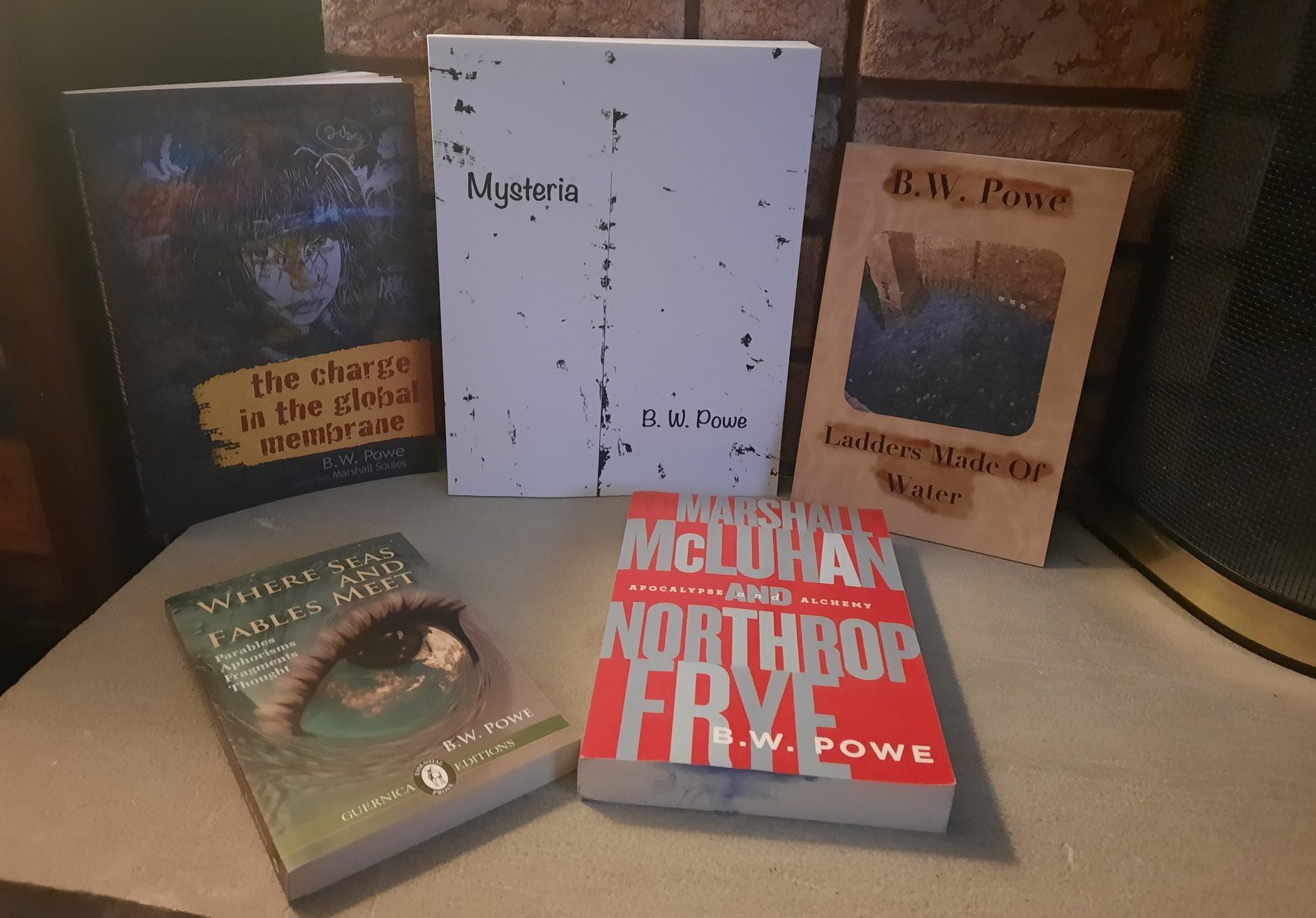
Stoking the Fires, a review of BW Powe’s “Marshall McLuhan and Northrop Frye: Apocalypse and Alchemy” by Wilf Cude

From The Antigonish Review, Number 186, Summer 2016: pages 117-123.antigonish-review

Here is the last paragraph of Wilf Cude’s insightful essay on B.W. Powe’s book.

Cude concludes:

“What are the laws at work?” The question, right before the close, is rhetorical. “These are what was called the two truths of the wisdom traditions”, B.W. replies, to himself and to us: “everything has two sides, which can be called the double vision and figure/ground, innocence and experience together, the visible and invisible always in vibrations of influence.” Two sides. Two books. A Climate Charged from so long ago and Marshall McLuhan and Northrop Frye: Apocalypse and Alchemy, from just about yesterday. Thirty years between them, and a well-lived life, innocence and experience. Two bookend books, bookending a remarkable academic and intellectual enterprise, when student Bruce William has come back as author B.W. Powe, fresh from frontiers, in a changed form, finally to meet his mentors again. On more or less equal footing, this time around. Let other new and vital lessons begin.


BW Powe’s Presentation. The Toronto School: Then, Now, Next. October 14-16, 2016

Title:
Into the Unknown and New:
McLuhan-Frye, Electric Processing, Imagination, the Poetics of Opening Time

Abstract:

The Marshall McLuhan-Northrop Frye Matrix represents visionary legacies of insight into the global theatre, electricity, imagination and identity, and a quickening search into the future, where the “medium is the massage” joins with “the great code”. This presentation appreciates the seers who discovered pathways to recognizing present patterns and manifestations, and then moves on to see how these ideas and perceptions are shaping a 21st Century poetics. They spoke of Closing Time, a prophetic awareness inspired by their readings of the metamorphic, associative Finnegans Wake. Electric Processing and Imagination together form the recognition that our crossroads is both a Closing Time and an Opening Time: an evolutionary hyperdrive–where paradigms break down and new forms of consciousness emerge, where terror and fear simultaneously surge with visions of higher forms of consciousness and keener hearts. The closings we see in raging phenomena like the Brexit, xenophobia, the rise of Trump and Putin; the openings we see in the desire for people and ideas to cross barriers and boundaries, in the compassionate welcome to others and a creative inventive now. Our new Mysteries are jolting,mythically immersive, severe and ecstatic. This carries the imperative of perceiving that primary shifts are now happening in awareness and sensibility. Beyond ideology and theory, we´re experiencing immediacy and trancendence, darkening and illuminations, the closing of minds, openings of the soul. Can we sense what higher and lower frequencies are beginning to play out?

Bio Blurb:

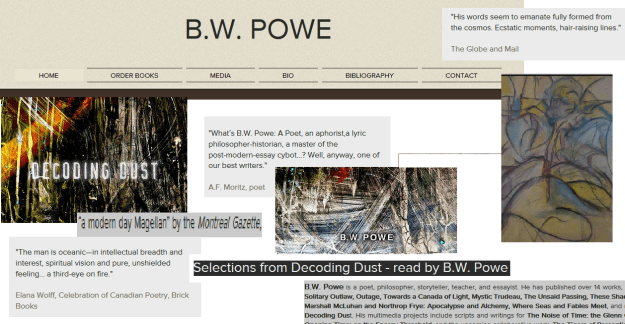
B.W. Powe is a poet, philosopher, storyteller and essayist. An Associate Professor of English Literature in the Department of English at Toronto’s York University, he teaches courses on visionaries and the legacies of McLuhan and Frye. He was affiliated from 2011 until 2016  with the University of Catalunya in Barcelona, Spain, where worked on a virtual project called Opening Time: On the Energy Threshold,  with Cristina de Miranda Almeida and Matteo Ciastellardi. His newest works are Decoding Dust (poems and dramatic monologues) and The Tigers of Perception (a multi-media lyric essay).

Correcting the Errors in the Ottawa Citizen article, Friday March 4th, 2016

To the editors of the Ottawa Citizen:

Ottawa CitizenThere are two errors in the Ottawa Citizen piece on my book on Marshall McLuhan and Nothrop Frye and my presentation at Carlton University that very much need addressing:

One: I am not the Creative Writing Program Coordinator at York University. I haven’t been since July 2014. The CW Coordinator is Michael Helm, a well known and much respected novelist. He’s been doing a remarkable job, and deserves the acknowledgment.

Two: I would never have said (and could never have said) Marshall McLuhan didn’t read books. He read voraciously. What I said must have been this, “His preference was for the oral.”  I talked about how he listened deeply to the voices in poems. I said that his primary sensory approaches were oral-audile-tactile. And that he encouraged us to both read and listen to the books of the world.

I would never have perpetuated the cliche and misconception that McLuhan somehow didn’t read.
In fact, he was much more of an attentive practical literary critic (following in the I.A. Richards’ line) than was Frye. Frye tended to read poems in terms of how they fit his grand theoretical scheme. McLuhan always looked closely at a poem, instructing us on its tonalities, rhythms, forms and effects.

This is important to convey.

I hope these necessary corrections will be acknowledged.

Yours truly,

B.W. Powe