Author Archives: bwpowe

William Blake, Richard Holmes, Northrop Frye, and Canada: An unpublished letter by BWP to the New York Review of Books

To the Editors of the New York Review of Books

Regarding Richard Holmes article, “The Greatness of William Blake” (NYROB, December 3rd, 2015)

Dear Sirs,

I’m an admirer of Richard Holmes’ writings. His biographies of Coleridge I keep close on my book shelf. So I turned to his essay, “The Greatness of William Blake”, with anticipation. I was rewarded with pleasures. He writes a rich Pater-ish prose. I’ve always been impressed with his keen sympathy for his subjects. But I was startled, when, after his summary of the ideas in Heather Jackson’s Those Who Write for Immortality, towards the end of his essay, he joins Northrop Frye with a list of American writers. I may have misread his meaning, but he implies that Frye is part of an American discourse. Frye was born in Quebec; he grew up in New Brunswick, and then spent the greater part of his teaching life at the University of Toronto. All of his major works were written in Toronto.

Holmes rightly says there are many Blakes. And there is a Canadian Blake. The Canadian cunning sublime tacitly diverges from the American imaginative vision and critical debate. So we must diverge, lest we be overwhelmed by the cultural force of the Empire to the south. Frye reinvented Blake in his masterwork, Fearful Symmetry (1947), turning him into a dissident of the imagination, envisioning alternative states of consciousness, heightened states of being, malleable realities, a politics steeped in the missionary imperative to restore visions of a utopian Jerusalem, an exaltation of a singular, prophetic voice calling from the wilderness or the margins.

You find another example of Frye’s radical Blake-like statements in The Educated Imagination (1962). There he heretically (and beguilingly) says that the imagination prevails over ideology: imagination is the source not only of reverie but of transformation. Frye championed seeing realities, not just one reality, on the material plane. His posthumously published essay, The Double Vision (1991, the title drawn from one of Blake’s letters), carries this myriad-minded vision to its extreme: death becomes a mental category, all dimensions of reality subject to poetics. Frye’s insights burned from the intense inwardness of the life he found in Toronto, and from his recognition of the frontiers of the new, northern experience.

His eminent colleague in the English Department at the University of Toronto was Marshall McLuhan. The various McLuhan often turned Blakean, identifying changes of cognition with changes in media (we become what we behold). Blake’s spectacular engravings and visual illuminations influenced McLuhan’s multi-media works, especially The Medium is the Massage (1968) and the aphorisms and advertisements of Culture is our Business (1970). McLuhan’s teasing satiric and revelatory impulses were indebted to The Marriage of Heaven and Hell. If there’s anyone we can claim to be prophetic—uncannily so—it’s McLuhan, who foresaw electronic technology changing how we communicate, what we sense and intuit, even consciousness itself. The global village vision came from a thinker living in a city that wasn’t then the centre of anything.

You can see Blake’s influence through the impact of these formidable teachers (Frye and McLuhan directly and indirectly educated generations of writers, teachers, film-makers, musicians, and politicians) and in many searching Canadian figures. Look at Margaret Atwood’s parables of catastrophe; Irving Layton’s apocalyptic reimagining of the poetics of identity; Leonard Cohen’s phantasmagoric Beautiful Losers (1966), and his beautiful early lyrics of innocence and experience; A. F. Moritz’s elegiac poems where dreamlife and perceptions of mortality fuse; in Michael Ondaatje’s first fictions that spiritedly mix modes. Anne Carson seems to stand aside from the Blakean current in Canada by making Sappho, Euripides, Simone Weil, Emily Bronte, her imaginative companions and collaborators. Yet in Carson’s unique writings there are muted tinges of Blakean ecstasies: her books combine poetry, prose, dramas, images, aphorisms and essays.

I doubt if the redoubtable Holmes would have said that the great Mexican poet, Octavio Paz (himself in Blake’s thrall) was inside the American discourse. You could say Paz is, like Canadian artists and thinkers, part of the Americas. Still, there is this persistence in melding Canadian writers with the Emerson, Whitman, tradition and with contemporary theorists in the United States. This forgets one of Blake’s great auguries: the visionary imagination–charged with paradoxes—is audaciously unique to a time and place, and without borders, a mental realm that gives shape to a communion of inspirations and perceptions. The poetic spirit, unlike Wilde’s muses, doesn’t care for geography (or history) and yet does care.

B.W. Powe

Nomination of B.W. Powe for Six Book Awards 2016 By Dr. Alex Kuskis (Media Ecology Association)

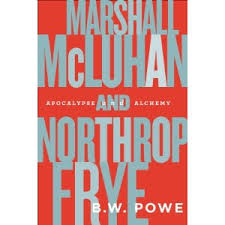
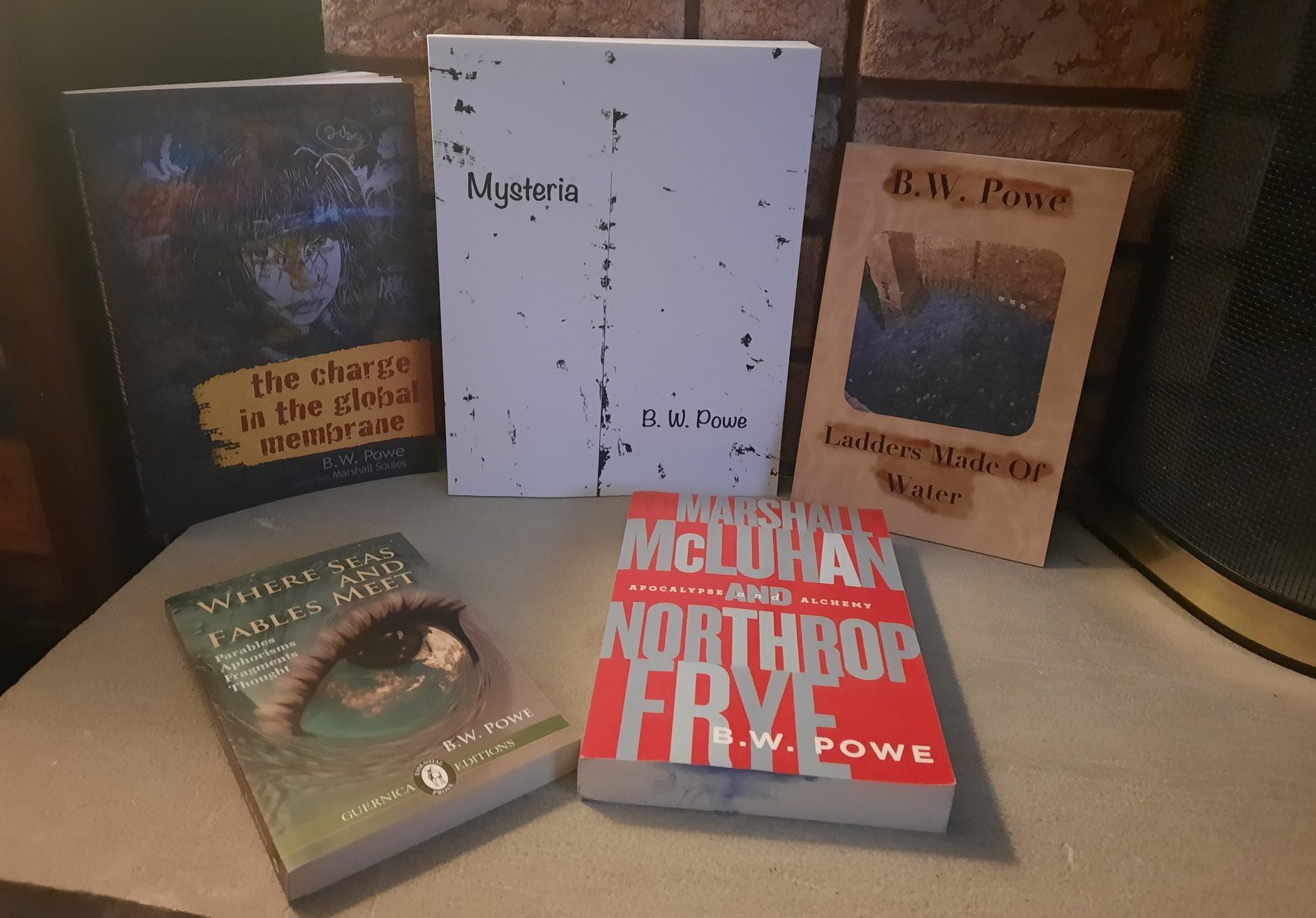
BookMarshall McLuhan and Northrop Frye: Apocalypse and Alchemy (2014). Toronto: University of Toronto Press. Dr. Alex Kuskis has nominated it for the Marshall McLuhan Award for Outstanding Book in the Field of Media Ecology. It will also be considered simultaneously for the Erving Goffman Award, the Susanne K. Langer Award, the Dorothy Lee Award, and the Lewis Mumford Award.


Cover Seas and Fables MeetWhere Seas and Fables Meet: Parables, Aphorisms, Fragments, Thoughts (2015). Toronto: Guernica. Dr. Alex Kuskis has nominated it  for: The Mary Shelley Award for Outstanding Fictional Work. 

A.F. Moritz (Poet, award winner, 2009 Griffin Poetry Prize), commenting on “Where Seas and Fables Meet”

B.W. Powe

What’s B.W. Powe:

a Poet,

an aphorist,

a lyric philosopher-historian,

a master of the post-modern fiction-essay cybot… ?

Well, anyway, one of our best writers…

                                A.F. Moritz, August, 2015

Review in Brick Books of “Where Seas and Fables Meet” by Elana Wolff, poet, essayist, critic and editor

Brick Books

The work of B.W. Powe invites mindfulness. The man is oceanic—in intellectual breadth and interest, spiritual vision, and in pure unshielded feeling. Powe crosses genres. He’s billed as a philosopher, poet, scholar, and novelist. He calls himself a neo-romantic, hyper-modern transcendentalist, and the mouthful fits. An early student of Marshall McLuhan, he’s as at-home in the wired world of global connectivity and vibrational ESP as he is in a clearing in the woods in the pages of a fable; as concerned with spirit-journey as with the journey of body and mind.

I encountered Powe the poet first—in two emotive poems that appeared in Exile Quarterly. What struck me: no man in Canada is writing this kind of rapturous, self-revealing, un-ironic lyric. I wanted to read more. The two Exile pieces reappeared in his first poetry collection, The Unsaid Passing (Guernica Editions, 2005), among other unabashedly passionate, heartfelt poems. Powe’s newest release, Where Seas and Fables Meet: Parables, Aphorisms, Fragments, Thought (Guernica Editions, 2015), soars out from his earlier collection like a third-eye on fire.

Open the book like bibliomant, eyes closed, and pick a passage. There will be riches. Powe draws broadly—on Baudelaire, Bachelard, Canetti, and Sappho. Neruda, Nin, Beckett, and Joyce. Proust, Jung, Rilke, Anne Carson. Kafka, Kafka, Kafka, and so many others. The short, eclectic pieces bear titles like “Living in New Beginnings,” “Grace,” “The Library of Mysteries,” “Mystic,” “Affirmations,” “Loving Destiny,” “Signs,” “Soul Veils,” “Re-visions,” “A Lantern Mind,” and “Vibration-Beings.” They feel oracular.

One name that doesn’t come up is William Irwin Thompson, though it could. Reading Where Seas and Fables Meet brought me back to my graduate days at York University, circa 1982. As I was walking through Central Square on the way to Scott Library, a title in the bookstore caught my eye: The Time Falling Bodies Take to Light. Royal blue cover, golden lettering—centered and descending into an image of William Blake’s engraving of “The reunion of the soul and the body.” I had no idea who Thompson was and no funds to spare, but I went in and made the purchase anyway. That might have been the first time I consciously bought a book for its title and cover design.

At the time, I was reading things like Rational Decision-Making by Janice Stein, Power, Influence and Authority by David Bell, Canada as a Principal Power by David Dewitt and John Kirton, and translated pages from Antonio Gramsci’s Prison Notebooks for a course on Italian communism. William Irwin Thompson’s Time Falling Bodies was an axe. There’s a line in Powe’s Seas and Fables that hits it: “Some books crack you open so that you’re the one who’s read.” Back in 1982, I felt cracked open by Thompson—opened and disclosed.

Thompson was talking about the decline of the militarized nation-state, an emergent planetary culture, the resacralization of art—to embrace myth, mysticism, and the suppressed feminine. He was advocating the recall of universal vision in religion, cultural regeneration, cross-fertilization of science, religion, and art. Anarchic freedom of expression. It was grand and heady stuff and made for much more evocative reading than Canada as a Principal Power and Rational Decision-Making. But I stuck with the latter, at least for a few more years. Then poetry and art prevailed—a kind of creativity that felt more vital, soulful, and true to life.

Reading Powe now calls up soulfulness anew. In Powe power comes from candour and ardour. And spirit/light—imagination. There’s hopefulness for growth toward a “world-soul”—emerging from the personal “in a cosmos created by love.” In Powe it’s the impersonal that imprisons: any kind of tyrannical “Structure,” and “monstrousness that comes from looking down on our desire to love and be respected.” The “critic” Powe has yielded to Powe the lover; a younger man’s “attack”-mode to a mid-life writer’s gratitude—for beauty already extant and wisdom potentially present: “Now [as] perpetual destination.” It may be idealized, but there’s a truthfulness in Seas I want to glean from and believe.

Elana Wolff, poet, essayist, critic and editor

Review of “Where Seas and Fables Meet” by W. Terrence Gordon, author, critic, McLuhan biographer, scholar

B. W. Powe’s Where Seas and Fables Meet gathers parables, aphorisms, fragments, and thoughts but collectively transcends and even defies those labels.  Powe’s great gift as a writer here is not in applying a formula for drawing readers in but in displaying an openness of mind and spirit that invites readers in. When he writes in elegiac mode, as in Sad Angel, one senses at once aCover Seas and Fables Meet delicacy and tenderness that is too often missing from conventional elegies and their inevitable conclusions.  Indeed, one of several possible conclusions to Sad Angel is evoked not within the text itself but in a later selection titled Monstrosities.  No matter the subject, and they are very broad ranging in this collection, Powe consistently achieves exemplary balance.  Skepticism about the questionable benefits of technology, of a piece with Powe’s penetrating study elsewhere of Marshall McLuhan, is set against thoughtful analysis of the positive effect – McLuhan’s key word – of student uprisings in Montreal and Quebec City: “The iBrain generation (supposedly unfocussed and self-absorbed) found focus in the cry against calcified thought.”  The sheer range of Powe’s subject matter is exhilarating: Dante’s Commedia complemented by a closing passage of the book addressed in a very personal way to every reader; a selection addressed to Richard Dawkins, moving (movingly) within a  few  pages to “what we hope will be illuminations of the larger soul;” the coincidentia oppositorum of  The Angelic and the Demonic  running throughout the book; Powe in overdrive with  four passages titled Wilde Things that anchor the reflections in Wilde and transport the reader by the end of the fourth into a Brechtian moment.   Powe gives us guffaws in the midst of the most serious topics (Identity Crisis) and gasps of wonder at his metaphors: “The Morse Code of the heart is love.”  Much of the time, he is a latter day James Joyce, reaffirming that he is here to read the signatures of all things: “The trees rustle in the wind, the  trees whispering what seems to be the word ‘yes,’  The trees have letters too.”  Where Seas and Fables Meet is a book that makes you hold your breath and allows you to finally let it go only with the greatest reluctance. Inspiration, literally.

W. Terrence Gordon, author, critic, McLuhan biographer, scholar

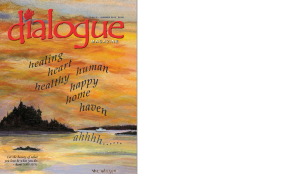
Review of “Where Seas and Fables Meet” by J.S. Porter in Dialogue, Summer 2015

BOOK REVIEW B.W. Powe – Where Seas and Fables Meet: Parables, Aphorisms, Fragments, Thought (Toronto: Guernica, 2015) A Review by J.S. Porter Thomas Merton, the Trappist monk Magazine Dialoguefrom Kentucky, had the ambition of writing A Book of Everything: “I have always wanted to write about everything…a book in which everything can go. A book with a little of everything that creates itself out of everything. That has its own life.” He wrote these words twelve years before his death in Bangkok by accidental electrocution in 1968. With The Asian Journal (posthumous), Merton was finally able to realize his ambition – a book of everything – his last photographs, speeches, prayers, travel notes, reading notes and poems.

Still early in his career, B.W. Powe in Where Seas and Fables Meet has written a book of everything. A book of stories, analysis and theory, Wilde Things, Marginalia and Delphic Ironies. Along the way, he writes an essay on the film director Stanley Kubrick and positions Kafka as the one indispensable seer of our time.

The Wilde Things are a kind of homage to Oscar Wilde – jokes, puns, paradoxes and witticisms. Powe at play. (He thinks Wilde should be called Whitman and Whitman Wilde.) The Delphic Ironies tend to be Powe in thought. And the stories, Powe imagining. He blends paradox, technology-probes, story and dream into an exuberant affirmation of human possibility. While you’re reading, keep in mind the closest parallel I can think of – the Uruguayan author Eduardo Galeano’s The Book of Embraces which also joins poetry and politics, journalism and storytelling. “A neo-romantic hyper-modernist,” a bricoleur with his bricolage, Powe embraces the world, both the physical and the electric. He’s a magpie picking up life-sustaining seeds wherever he can find them.

The stories for me are the most enchanting part of the book. (Powe uses the words fable, parable and story interchangeably.) One story has to do with the mystery of finding a copy of Charles Dickens’ A Christmas Story by the open-pit fireplace of a cottage by a lake. No one claims to have put it there. Another has to do with why Thomas Aquinas abandoned his writing and didn’t complete his Summa Theologica.

My favourite stories are:

1. The story of Grace, a young French girl who believes, in spite of her psychiatrist and the asylum in which she finds herself, that “All is well.” (Was the story inspired by Julian of Norwich’s words? “All shall be well, and all manner of things shall be well.”)

2. The story of the boy and the angel, entitled “The Sad Angel.” A boy plays with an angel until he grows up and goes to school and leaves behind childish things. Years later on a vacation in Brazil he sees a sad angel in a cathedral. For a moment it seems that the boy, now a man, might, through a work of art, regain his childhood loss. But the moment passes. He doesn’t recover the source of his first enchantment. (Did Powe have Dennis Lee’s Nicholas Knock and the honkabeest in the back of his mind?)

3. The Story of the Yoga teacher with the posture of a tree, called “The Tree of Paradise.” In this story, a stretching woman in a tree-like balancing position in her backyard, suddenly feels “a warm blow to her right cheek” and falls, breaking her leg. Different theories ensue: The son believes she was hit by a comet; then he modifies his point of view a little by saying she was hit by a light. The husband believes she lost her footing and fell over backwards. The woman believes that she fell from a tree while reaching for a red maple leaf, a symbol of love. Which belief is true? As in Yann Martel’s Life of Pi, you can pick the one that is richest for you. The woman goes on to found a Yoga school called Comet Yoga.

These three stories demonstrate the power of story – the power to transport, to cast spells, and to enrapture. In a mini-essay on story, called “The Story,” which itself transforms from a lecture on the deadening effects of elaboration and explanation to a parable on story’s power and its capacity to incorporate explanation into new formations of narrative. This short piece brings to mind Susan Sontag’s famous essay, “Against Interpretation,” where the intellect tries to tame art, but art slips through its nooses.

Ovid and the Canadian Ovid, Marshall McLuhan, are the guiding spirits of this book. Things change, viewpoints change, the self changes and you must resist the Structure (Powe’s word) that would calcify, shackle or inhibit the free-flow of the imagination. “We are all under sentence of death,” as Walter Pater reminds us in his conclusion to The Renaissance, “but with a sort of indefinite reprieve.” “[W]e have an interval, and then our place knows us no more. Some spend this interval in listlessness, some in high passions, the wisest, at least among ‘the children of this world,’ in art and song. For our one chance lies in expanding that interval, in getting as many …/ pulsations as possible into the given time.”

B. W. Powe, like a child of the world, fills his interval ecstatically in art, song and fable. He delivers multiple pulsations. Where Seas and Fables Meet is his most personal and intimate book. It’s Powe unbuttoned, freeranging and wild. It’s my personal favourite among his ever-growing contribution to Canadian letters. – J. S. Porter, Toronto ♣

Note from Marshall Soules, writer, professor and media theorist, about Where Seas and Fables Meet

Where Seas and Fables Meet – a magnificent and inspiring work.
It expresses your liberation philosophy, with much that is personal, woven into rhapsodic layers. Threads gain resonance; fables and anecdotes hang in the mind (and heart), ready to bloom and reach for the sky – music of the spheres. It soars.
I love the story about Comet Yoga, its tree imagery, and dueling storytelling between mother and son.
And as a student of media, I appreciate your wisdom and insights about the Structure, places of dissent and openings, wave gypsies and their networking.
You are writing beautifully, my friend, in a voice brimming with wisdom and love.
Marshall Soules, 2015

Review of “Where Seas and Fables Meet” by Dr. R. Andrew Paskauskas, University of Toronto, and author

On the back pack page of Where Seas and Fables Meet: …, we read that B.W. Powe is first and foremost a philosopher; followed by poet, novelist, and essayist. The ordering is fitting because Cover Seas and Fables Meethere, in his latest contribution to world literature, Powe forges in the smithy of his soul a remarkable assembly of shorts – Parables, Aphorisms, Fragments, Thought – that differs significantly from most other philosophers of the not too distant past. Indeed, his writing is highly accessible (it is neither abstruse, nor is it laced with terroristic obscurantism).

Seas and Fables… exudes profound, at times humorous, thought provoking insights into the human soul. The principal universal of interest for Powe is Light. Concomitant with his consuming passion with Light, and all of its manifestations, is the Structure (at one time the System, and its equivalents) which encompasses all forms of mind and soul crushing (political, technological, emotional, spiritual, economic, and so on). As a countermeasure to its onslaughts Powe identifies possible psychological strategies for liberation, or attempts to escape through self-expression; his own and those employed by others (Blake, Nietzsche, Whitman, Kafka, Kubrick, Bellow, Yuri in Zhivago, Grace in … Seas and Fables … ).

Physicists tell us that if we were to travel at the speed of light, a universal constant of nature, time would stop entirely. At the still point, where past and future are gathered, viz. Eliot’s Four Quartets (an acknowledged favorite of Powe’s), we might consider the possibility of encountering God, who always was and always will be.

It is there, at that singular point, where time stands still, that the laws of Space-Time breakdown, and we may experience what the theologians call the beatific vision (universal-absolute Light). This is why Powe’s fascination with Light and accompanying images (waves, ripples, vibration-beings, Tsunamis of the global soul, shadows, cosmos … ) or transcendent realms – metamorphosis, theos (by extension theoria, theosis), sacred, noosphere, fantasy, signs, words, creation, angels, Mystery, Word, Spirit, grace, metamorphosis, infinity – in this and his other works (Outage; A Tremendous Canada of Light; ed. Light Onwords, Light Onwards; Mystic Trudeau; The Unsaid Passing; These Shadows Remain; … Apocalypse and Alchemy, and others) is of such crucial significance – by following his inner voices and not the orders of others, he creates a path towards the blessing of peace: to breakthrough the Structure, and embrace the Divine.

Andrew Paskauskas
Toronto
April 7, 2015