We are proud to announce that Mysteria is now available for purchase through the website of our publishing venture, Stream Elsewhere Press. Click in the image below.

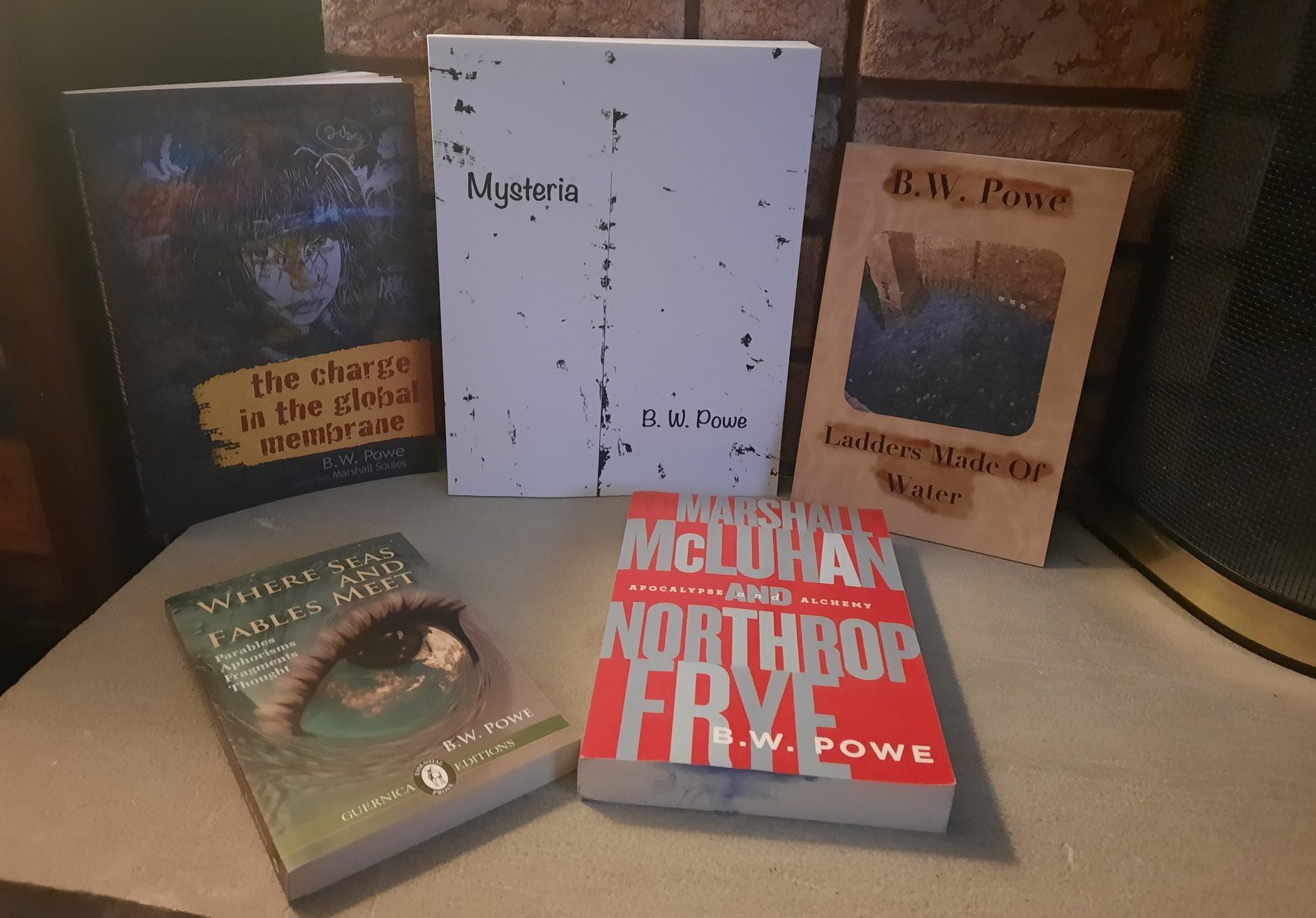
We are proud to announce that Mysteria is now available for purchase through the website of our publishing venture, Stream Elsewhere Press. Click in the image below.
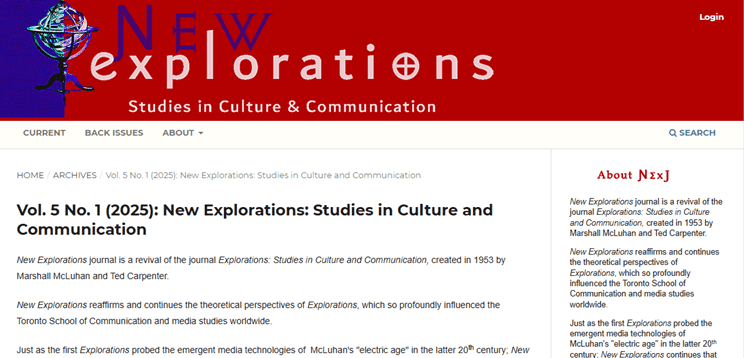
Click the image to access Vol. 5 No. 1 (2025)

Click the image to access the article

Click the image to access the article

Click the image to access the article

Click the image to access the article

Click the image to access the article

Click the image to access the article

Click the image to access the article

Click the image to access the article

Click the image to access the article

Click the image to access the article

Click the image to access the article

Click the image to access the article

Click the image to access the article
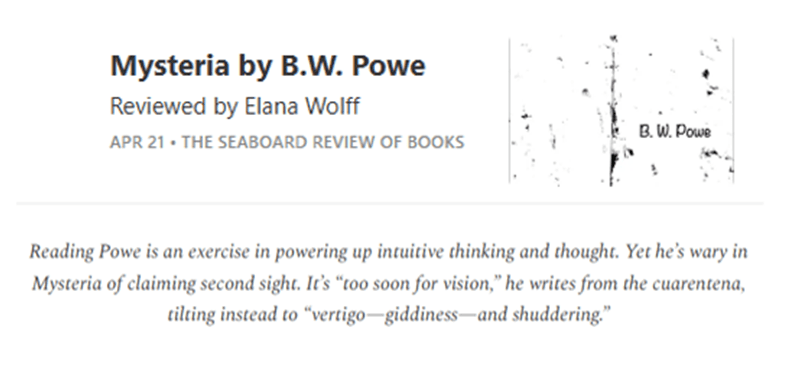
Click on the image to read the full review
B.W. Powe’s Mysteria is an exquisite volume exploring the beautiful and irresolvable
contradictions that illuminate and darken life, reproduced to show pen and ink process and print text firmness. He invites us to feel our hurt earth, the collision and soft meetings of Spain and Canada, alongside such pairings as community and solitude, presence and absence.
Jaqueline McLeod Rogers, Ph.D.
Latest Book: Crises Then and Now (Peter Lang, 2025)
Author/Professor
We are riding a whirlwind roused by the devil himself. Damnation is our new daily bread. I think B.W.P. is wiser, retreating into those deeper, silent recesses he describes so vividly and with such emotional force in Mysteria.
–William Kuhns, Media Analyst, Archivist, Author, Novelist,
Biographer, Cultural Historian
Moody sounds and powerful songs written to accompany your readings of B.W. Powe’s Mysteria and Ladders Made of Water.
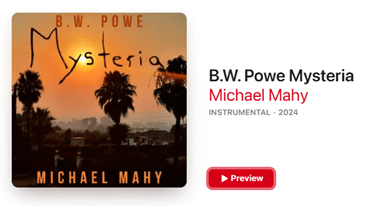
Mahy’s memorable music is available on Spotify, Apple, Amazon, and other song sites.
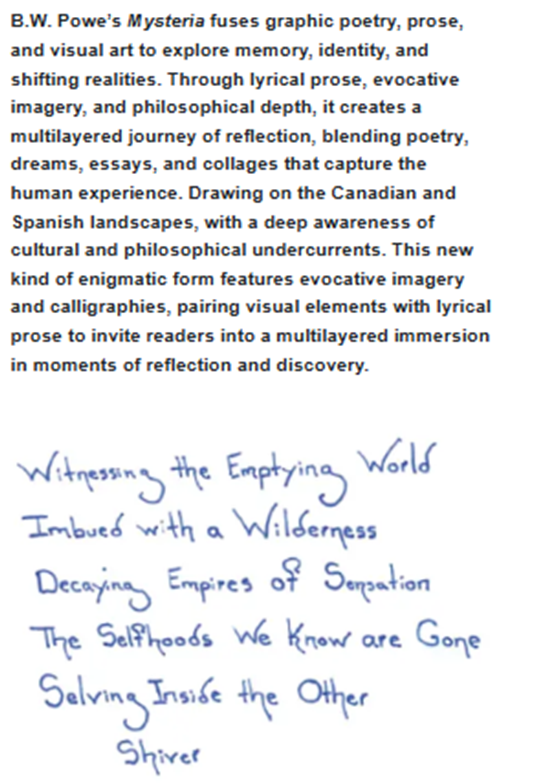
Mysteria by BW Powe, is an excellent work of art and a must-read. The handwritten font of the pages echo the motif of wind and waves that runs throughout the work. The curling letters and sharp lines embody the meaning of the words in the form of the font and there is something deeply soothing about that. It brings the reader immediately somewhere more personal than a mechanized font would. To read and engage with Mysteria is to engage with an interdisciplinary and deeply personal work of poetry, prose, and art – that spans Cordoba and rests in many ways in Toronto. However, what stands out most and what I come back to is the form – the handwriting which is Powe’s own, the attention to the pages and the unique structure makes Mysteria more than a poetry collection or an artists’ book but a piece of art in and of itself.
http://www.spiritbookword.net
(for Sean Malone—poet, reader, friend)
“An empty page is a paradise inviting you to a feast.”
“We tell stories so we won’t disappear.”
Mysteria, a book of love, a book of dreams, is brave and wild and raw and magnificent.
In my many years of reading, I’ve read nothing like it. I shook a number of times when
reading, especially in the tender intimate snippets of language between husband and
wife. The author was able to put so much love on the page; at times it was almost
unbearable. He gave so much of himself; that too was almost unbearable. How can he
be so naked? How can he move on the page without protection?
When I worked in Zambia years ago, when I entered the inner sanctum of dialogue with
a Zambian friend, he would say “too close” and I knew I had to back away or run the risk
of burning myself or burning my friend. Powe in Mysteria risks violating the inner
sanctum; he touches it a few times, but he keeps it whole and keeps himself and his
wife whole.
Harold Bloom says for a work of literature to have legs, to exert power, to endure, it
needs at least three qualities: strangeness, mystery and cognitive power (imagination).
Powe displays all three in Mysteria. To Bloom’s trinity, I’d add life-kick or life-surge or
pizzazz, and Powe’s book has that as well. For all its mixing of genres, Mysteria is a
love letter to the author’s wife and children and in-laws. It’s a love letter to the world,
every pool of water, every scrap of sky. It’s a love letter to life.
Note the strangeness of the word Mysteria, Latin for mysteries. Mysteries as a word is
neither particularly strange nor mysterious, but mysteria is. It’s foreign enough to sound
distant and familiar enough to sound familiar, and it ends in a vowel: a (ah), the sound
of our longing, the sound of our pain, the strongest letter in the alphabet—a, alpha,
beginning.
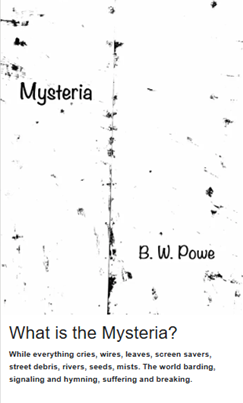
There are other sources of strangeness. The cover of the book, created by artist and
author Marshall Soules, sports Pollock-like black drips and smudges on a white
background in the front cover and white splotches on a black background in the back
cover. The front cover is spare and minimalistic while the back cover is crowded and
maximalist. The vertical line running top to bottom on the front cover “suggests a
crease/fold, yes, and also an opening/closing, a gateway/a way out or in, a scar/a
stitched wound,” according to Soules.
Mysteria uses handwriting, a pale blue (the author’s) and typeface (in different fonts); it
has a homemade, handmade feel to it. It also has a cast of familial characters.
the author (husband, father, son)
his love (wife)
a grandfather (Abuelo) and a grandmother (Abuela) to whom
the book is dedicated
a younger daughter
an older daughter
a lost son
an ex-wife
twins (stillborn)
an uncle who tries and fails to introduce to the author Jean-
Paul Sartre and Simone de Beauvoir sitting at a restaurant in Paris
a dead father
a dead mother
The book proceeds in dream, parable, chant, poem, playet, homage, unlettering,
anecdote, smudged words, fragment, proverbs, elegies, eulogies, epigraphs and an
exciting spin on the Beatles and their contribution to sound and the human sensorium.
The book is a grand paella into which the author, shuttling back and forth mentally from
the snow and ice of Stouffville to the sun and wind of Cordoba, has thrown his life, his
knowledge, his wisdom. The book of love and dream and survival is conceived during
the time of Covid, primarily in Spain, “in solidarity with people falling apart.” In the
author’s words, it consists of “stains, scars, illegibles, blurs, scratches, dissolving
reshaping…,” a “search for a source”… “a beginning.”
The poetry sings in the opening pages (as in all the pages of the book, unnumbered).
“But what is the mysteria?” the author asks from the safety of Canada, remembering the
danger and devastation in Spain.
Remembering silenced Cordoba
and moonlit Sierras
remembering dazed people
In a billion cuarentenas
in small rooms with many open windows
our struggle for radiant life
Viruses, or plagues, are not new and neither are written responses to them. But no
virus, no plague, to my knowledge, has had the worldwide devastation of Covid-19 –the
deaths, the hospitalizations, the isolation, the disconnections, the divided families, the
fear and anxiety. And, while plague literature is not a new phenomenon—one thinks of
the Bible or Albert Camus’ La Peste or even Daniel Defoe’s A Journal of the Plague
Year—there is no work of literature in my reading quite like B.W. Powe’s Mysteria in its
myriad forms and use of poetry to tell a story at once particular and personal and also
universal.
As in all new literature, it builds on old literature, with slivers of Whitman, flashes of
Lorca and Leonard Cohen, proverbs that bear direct connection to Marshall McLuhan’s
aphorisms and Blake’s “Proverbs of Hell” in The Marriage of Heaven and Hell, and
language-play reminiscent of James Joyce.
For the last ten or so years, Powe has been embarked on a venture of communicating
more and more personally, intimately, and with more and more flair. He has already
defined a book as “truly one person speaking to one person.” Mysteria is one person
speaking mostly to his love (wife) as if in a shared dream, sometimes nightmare. We
readers eavesdrop on the conversation.
Powe has of late been experimenting with new ways of book-making—Mysteria being
his latest and most accomplished experiment. The first big paella—where whatever is
at hand goes into the dish— is Where Seas and Fables Meet: Parables, Aphorisms,
Fragments, Thought (2015); then, The Charge in the Global Membrane (2019) where
his words and Marshall Soules’ images play off each other; then Ladders Made of
Water (2023), a foretaste of Mysteria and another paella of hybridity and mixed genre.
And now Mysteria (2024), which grounds itself in two important prefixes: un, as in
undefining, unlearning, unframing, unmooring and unlettering and mis, as in
mistranslating, misreading, mishearing and misremembering. When the virus hits,
people unravel and often misjudge the long term effects.
Powe’s novel ways of bookmaking bring to mind some of the experiments of fellow-
Canadian Anne Carson. In Nox (2010), she intermingles photographs, ephemera,
dictionary definitions, lyric shards, fragments, cutouts, clippings, handwritten jottings
and incomplete narratives. Float (2016) houses separate disparate pamphlets in a
plastic container, H of H Playbook (2021) showcases her drawings as well as her
translated words from Euripides, and Wrong Norma (2024) couples her whimsical
drawings with her fiercely piercing words.
If there is a Canadian tradition here of making mongrel works—Powe and Carson
running on parallel tracks—then bpNichol is maybe the father of it all: “everything at
once/altogether/completely tangled together…” https://bpnichol.ca/contributors/bpnichol
Powe’s particular contribution to literary mongrelism inheres in that most mongrel of
cities, Cordoba, where Muslim, Jewish and Christian cultures have co-existed for
centuries.
In the middle of the book, the author asks two questions in Spanish: Can you live within
a story? Can you live inside a song? The answer is yes to both questions. The author
lives within both story and song, within this blue handwritten song, for example.
More Letters on the Bridge
Read us
The trees were made of music.
Your song always loved the sun,
the moon,
the winds,
and the rain.
You struggle
to say this
You struggle
to hear this.
The trees were made of music.
Sing us
You need a guide for brave expeditions. The author’s guide in the writing of his book is
a Sufi mystic, Ibn Arabi, with the inevitable drop-ins of Don Quixote, the father of
Spanish dreaming. Arabi was a 12 th . and 13 th . century “philosopher of an original,
imaginative unity. He wrote against tragedy.” What his theory of unlettering means to
Powe is “peeling away your preconceptions/seeking what’s momentary without a
gloss/unfiltering your clogged senses/breaking from a domineering concept of reality.”
As I read the author’s book of dreams, his book of love, my guide is Mary Oliver,
particularly her poem “Mysteries, Yes” in which these lines hover and land:
Truly, we live with mysteries too marvelous
to be understood.
…
Let me keep my distance, always, from those
who think they have the answers.
Let me keep company always with those who say
“Look?” and laugh in astonishment,
And bow their heads.
When you read Mysteria, you tend to read it as you suspect the author may have written
it – with your feelings, your imagination. You see and understand feelingly as if you too
are a part of the book, a kind of co-author and the empty margins are meant for you to
fill. As in the inventive playet, “Sensation is the Revolution,” which includes a meeting
and a dialogue with Yoko Ono, John Lennon, Marshall and Corinne McLuhan, you
gradually open to the idea that the revolution we’re all immersed in is more sensation
than ideology, that it comes in “Technology plus sensorium, plus receptivity,/admitting
the newborn.”
The neural networking of the media is the offshoot
of the tree of life.
You’ve already planted aural seeds
in the atmosphere. (MM to Lennon)
How the author has grown, broadened and deepened since his breakout book, The
Solitary Outlaw (1987). With Mysteria, he joins at last the other solitary outlaws in his
band of mavericks and explorers – Trudeau, McLuhan, Gould, Lewis and Cannetti. With
Mysteria, he has written a book you want to keep, return to, and treasure.
Powe’s nearly final words in Mysteria, a book that deeply touches endings and new
beginnings, faithfully documenting the losses, the loss and the lost, bring me close to
tears:
My love my heart said, “I’ll gather
these pages and words
made of voices and spirits
from Canada, from Spain,
and someday I’ll carry them across
Cordoba’s bridge of dreams to a new home…”
Then one day when plagues pass
and AIs fill our screens,
the voices and the bridges olive groves and palms
the icy north-winds and crystalline blue skies
spinning particles weaving leaves
will speak to the life in the music that’s come to us,
come from us to all for all, everyone beyond fear,
to be always
always
now here
“’Tis a portrait of my mind,” said Laurence Sterne when Tristram Shandy was done.
One suspects that Mysteria is a portrait of B.W. Powe’s mind and heart. When Leonard
Cohen gave his last concerts in Toronto and Montreal, he began with these words, “I
don’t have much to give you. But I’ll give you everything I’ve got.” What makes B.W.
Powe’s Mysteria so painful, so powerful, and why in places I tremble, is the knowledge
that he has given everything he’s got – heart, mind and soul.
* J.S. Porter has written extensively on B.W. Powe’s work in Dialogue Magazine
http://www.dialogue2.ca/columnist-j-s-porter-page.html
and in Hamilton Arts and Letters
https://halmagazine.wordpress.com/2019/06/11/review-j-s-porter-b-w-powe/
He has also interviewed Powe with Bob Megens in the college magazine Kairos (1996)
where his “Notes on Outage” are also included, and in the ecumenical magazine Grail
(1997) with Michael W. Higgins.
https://spiritbookword.net/spirit/an_interview_with_bw_powe.shtml

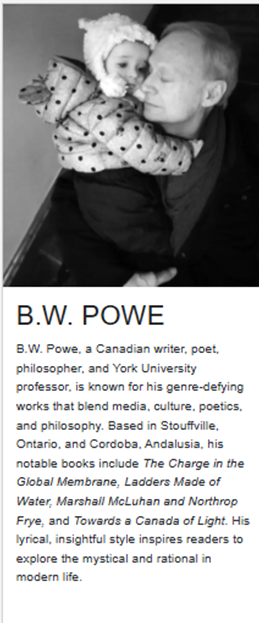

 BW Powe